The following analysis draws quotes, lyrics, themes, characters and evidence from Flash (时光代理人 Season 2) insert song.
时光代理人 is owned by Li Haoling, and produced by LAN studio and CMC media with the help of Haoliners Animation League. The donghua airs on Bilibili with the assistance of BeDream Studios.
___________________________________________________________________
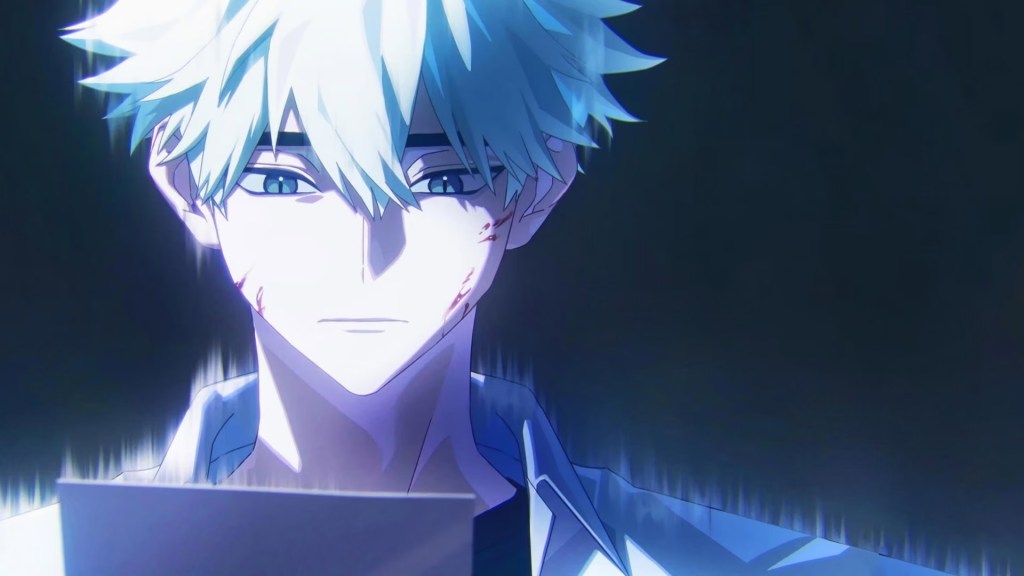
For context…
I’m mostly looking at this song in the way it was used in the Yingdu Arc Episode 6, as I think that is much more significant than its first appearance in Season 2 Episode 2.
In Yingdu, Xia Fei and Liu Xiao are watching a movie together. During the last scene of the movie, Xia Fei gets a phone call. Therefore, he is distracted and so are we, which means actually that not many people notice that the ‘last scene of the movie’ looks exactly like it’s from Season 3 Episode 3. And considering the following events of Xia Fei’s disappearance at the end of the episode, (back in present time) I can say it is.
Xia Fei’s phone call is more important however, as it relays the information that Vein is dead. When the camera settles on a shot of his body, Flash begins to play. Xia Fei goes to run out, and Liu Xiao tells him he’ll miss the big reveal. Where, in English, somebody in the movie recites “I feel like the mastermind behind the scenes hasn’t shown up yet.” Then, Lu Guang is the one who voiceovers during Flash. It’s almost certainly from his point of view, so I’ll be doing the analysis framed like it’s him. And I have to say, it’s much easier to understand after Season 3 – as there are more than a few references to both his childhood, and Cheng Xiaoshi’s fate. So, spoilers for both Season 3 and Season 2, and I’ll begin!
___________________________________________________________________
I can’t believe that you were here, I know I can’t do it. There’s no chance to rewrite, our story ended long ago…
Including this entire section is easier, because they all refer to the same thing. Most likely, Lu Guang directed at Cheng Xiaoshi after what went down. “You were here”, past tense, making it perfectly clear he is aware and has always been aware of what happened to him. Though it seems like he’s in denial, it’s almost as if he’s not, but wants to be. This is supported by a lyric later in this song, he says “I just wanna [want to] deny” – implying he hasn’t yet reached a stage where he can deny it has happened, but he wants to get to that point. This could be because even if denial is a very unhealthy thing, it feels hopeful for the people experiencing it, and it’s much easier than the situation Lu Guang is in right now. Which is being very aware Cheng Xiaoshi is dead. The next few lines also make it clear that he knows what he’s doing is hopeless, “I can’t do it” and “no chance to rewrite” both very pessimistic. Lu Guang once said in another song, 审判列车: “高处不胜寒 让我徒增不少悲观” which translates roughly to “it’s lonely at the top, so I step foot to gain with lots of pessimism” as a direct translation by my Chinese friend @Sui_2461 on Reddit. We both agreed, however, that it’s not really a proper phrase, so to make it work in English, it would sound a bit like “being by myself has made me more pessimistic” , or “being the only one in control/with knowledge means I only gain pessimism in return.” The reason I brought this lyric up is because like every other lyric in Flash, Lu Guang is perfectly aware of everything. He knows he’s given up almost entirely, and he’s embracing it, or trying to work around it.
“Our story ended long ago”, ever since the first timeline it has been written in history how it would end. Every attempt since that is meaningless. There’s also a tone on this line I quite like. Stories usually begin with “the story begins”, or “once upon a time”, or “the legend/tale started like this” – something along those lines. This lyric has the same tone, trailing off with obvious anticipation which I marked with an ellipsis. Something would continue after this, the beginning of a story, an explanation, “the story begins…” but instead it’s “our story ended long ago…” and it proceeds to tell you that long ago. The story is not of success, but rather of how the tale ended, and that’s how it opens.
The time is coming now
“The time” likely referring to the date we all know, September 13th, which is the only date Lu Guang would really be keeping tabs on. It’s yet again demonstrating surprising awareness of not only what happens to Cheng Xiaoshi, but when – as we know from his phone passcode – and how he’s aware of exactly how far away this date is. Not that it needs to be pointed out at all, but that suggests a lot of paranoia.
Blank, I wake up blushing my-
This song has some weird lyrics. This is up there. It’s difficult to interpret it in any other way than the obvious, but I think the cut off is a good example of Lu Guang’s nature. Filling in the gaps, it sounds like the line is supposed to be “I wake up blushing [from] my…” right? The “wake up” explicitly suggests the missing word is dream, and the keyword here is ‘blushing’ really – incredibly uncharacteristic for Lu Guang. So, then, if you infer this dream is sweet or tender, too much for his liking, he would cut this off out of embarrassment, or not knowing how to deal with any sort of feelings like this. (Gosh, I just wonder who this is about, huh?) Regarding his rather low emotional or social awareness, I wouldn’t be surprised if this line is cut off and confused because of the intensity of sudden feelings he can’t deal with. The cut off is intentional to leave it up to our interpretation, because he can’t or won’t name it. Waking up with a “blank” mind, then cutting himself off when it’s too difficult to admit how he feels, that’s characteristic of Lu Guang. His mind is probably blank because he’s overloaded, or it’s the feeling that’s blank because its unfamiliar and he can’t name it, or he does’t remember this dream and only the physical reaction stands to prove what it was about. What I also find interesting is the tone of this verse, and the lyrics just after this, that all feel like a bit of a ramble – like things are being admitted in a winding list of utter honesty from Lu Guang. There’s a lot of feeling in this song, and I’d associate the word desperation with Flash. This lyric is a part of a frantic section of confessions, and now somehow with that in mind, it fits.
Just a loop, a boring loop, should I do this now till the end?
Now, the loop is introduced as something almost… insignificant. “Just” a loop, a “boring” loop. There’s more brutal honesty, that maybe he’s done this for so long that the each life begins to hold less and less significance to him, and eventually it becomes his new way of living and nothing more. Somebody can look him in the eye and ask him, and Lu Guang would stare blankly and say it’s just the loop, and it ends the same way. That’s why the word boring suggests lack of change, for so long each one has had the same outcome. There’s a lack of empathy in that word too, this ending is becoming less and less hurtful and more like something he’s fed up of seeing. I’m not suggesting he’s not hurt seeing Xiaoshi die, I don’t think Lu Guang could ever “get used” to that. But he is reacting less each time. In Season 3 Episode 4, we are shown a version of his death where Xiaoshi dies at 23:11 and Lu Guang gets up and leaves at 23:13, utterly fine. Composed, not even teary, and focused on getting outside to Vein. (With something he intends to use as a weapon, nonetheless.) This attitude reminds me of the small chibi interview for Unforgiven, where Lu Guang corrects Wang Qing that instead of him feeling despaired seeing these memories, it only strengthens his resolve for revenge. The longer he continues, the more anger that builds instead of pain.
The next line introduces the idea of continuing this until the end. But what is “the end”, to Lu Guang? Is it until he dies? Until he goes insane from grief? Until Cheng Xiaoshi survives? The fact this lyric is worded like a question, “should I?”, makes it stand out from his previous awareness. Here, he doesn’t have an answer and is demonstrating hesitation in finding one. Asking if he should do something paints it as more of a moral question, he’s not asking if he can, he’s asking if it’s right. He’s not too far gone that he can’t stop and debate his moral choices, but I think the day where he abandons it anyway is near.
Into the story as just an extra
The way I see this is that, when somebody uses Cheng Xiaoshi’s power, they take up the body of somebody in the past. When Lu Guang does it, he takes up his younger self’s body, and eventually he consumes his younger self’s place in time. The Lu Guang that should be in that moment is now wiped from that reality, and this “extra” in the story takes his place. That’s how I see this line, he’s entering the story as an extra that is separated from the others in this time. But because of the butterfly effect, he doesn’t really have the power to change anything, which is why it’s phrased as “just an extra” again, creating insignificance.
You are the reason I live, but you don’t remember me?
Oh, we all know what this line means, so all I’m going to mention is after Season 3 Episode 1, the slight change that “you are the reason I live” has adapted. Beforehand, most of us assumed it was a romantic statement that couldn’t be taken literally and, let’s be honest, most of this line is probably still a romantic statement! But it is also a hard fact. When they first met, Lu Guang was weak, injured and starved. Cheng Xiaoshi took care of him, and over the course of their meetings, you can see Lu Guang progressively getting better. He still trips over a bit, sure, and eats too quickly to have eaten well previously – but he’s happy, he laughs, and the bruises fade quickly because there’s somebody tending to him. If Cheng Xiaoshi hadn’t found him and kept bringing him food, would he have been okay? Lu Dashan probably had no intention to starve or injure Lu Guang to the point of, well… but rather he seems like the kind of man that would do it accidentally in a temper. He’s not a nice person. But like Li Tianxi and Tianchen’s father, the worst happens in the heat of the moment and both men either cannot or don’t want to take it back. And if Lu Guang went too long without anything, too scared to bring it up, I’m sure as hell that man would not have ever noticed. So really, Cheng Xiaoshi is the reason he is alive, but also his reason to keep living at the same time.
Oh, can I be with you?
“Can I be with you?” – he’s either asking the person in question (Cheng Xiaoshi, anybody?) or some higher force if he is permitted to be with him. To me, I can see this has two interpretations.
1) If the question is directed to Xiaoshi, then it feels like Lu Guang deems himself unworthy of being with him. He dreams about it, quite openly in this song, but in reality is scared of his reaction to the things he has done, and therefore is not deserving of any sort of love. This kind of attitude could come from his childhood too. This is fitting to Lu Guang’s character but it’s unlikely it’s what this lyric means, I’ll explore the more likely version next. Quickly on the subject, I want to bring up a line from the 时光代理人 audio drama. The paid one with 12 episodes, not to be confused with the longer 100+ episodes one. I think in Episode 2, near the end, Lu Guang says this when explaining to Cheng Xiaoshi why somebody might not tell a loved one something: “the closer they are, the harder it is to talk about your troubles with them. You’re scared they won’t understand. Even more scared that they might get hurt [from it].” Clearly, he’s secretly talking about how he feels telling Cheng Xiaoshi what he’s hiding. I thought it was interesting.
2) If it’s a rhetorical question directed to a sort of unnamed force like the universe or time, then it’s as if he’s acknowledging somebody or something is in control, and therefore its a bit of a helpless question from somebody who knows it’s all gone to hell, sounding a bit like “why can’t I just be with you (him)?” The idea of it being rhetorical and directed towards a force like time is abstract but completely in theme with what we’ve seen from Lu Guang already.
It feels like comedy
Keeping in mind the interpretations from the lyric above, ‘comedy’ being a sort of reference to tragic comedy, or how the situation is so helpless it’s almost worth laughing at. I feel this lyric makes a bit more sense if we simply change it from can I be with you? It feels like comedy to why can’t I be with you? This feels like comedy the slight tense change might make it a bit easier to understand how I see it. It seems to be him expressing frustration and agony at the situation, again, uncharacteristically honest for the Lu Guang we know, further cementing the idea this song is supposed to represent his breaking point. Conveying this feeling through referencing a genre is a nice touch to Lu Guang’s appreciation for literature, and makes the song feel more like it’s from him.
Contemporary dance
It’s a twisted metaphor, probably, because a contemporary dance is wild and by definition involves: “dramatic movement, throwing the body around, things like wearing red to symbolise blood. Expressive in emotion.” An often wild, vibrant and sometimes grotesque performance. If we link the two lines it feels like comedy, contemporary dance – then it feels like a list, a small one at that, of metaphors (or a simile in the case of the first one) to describe the situation Lu Guang is in, which is a violent and heartbreaking scenario but is beautiful all the same and in the way the steps are always repeated, back and forth, the time travelling can be viewed a bit like a dance – which traditionally will repeat at certain points, and the pattern and rhythm remain the same with only small changes.
Please, lock me up
This line always stood out as being so irrelevant and unlike Lu Guang I could never pull anything from it. Now, I have a strong feeling I know, and I had actually written in a draft analysis of this song I wrote back in April that I felt this line and the next were referring to some unnamed trauma that wasn’t Cheng Xiaoshi’s death, rather the one I also believed was at the heart of other strange things (like, his obsession with cleaning and working, the lack of eating even though his profile states he loves gourmet food, and some more). I actually will cover this in a study of his character I’m working on, the first part of which I plan to release around his birthday – the 24th of October for those who don’t know. Touchy subject, but I’ll do my best. For now I want to say that yes, I also personally believe this line is a reference to childhood trauma. As a child, when he made a “mistake” part of the corresponding punishment dealt by his adoptive father, Lu Dashan, was being locked in what looked like… a filing cabinet? Similarly, after escaping from Lu Dashan, Lu Guang is then locked up in some sort of illegal juvenile/boys’ home situation for who knows how long. Here, it’s almost as if he’s asking for that same thing. “Please”, if we’re going by the logic of he feels the same consequences should be due for making a mistake like it was in his childhood, then him asking for it could either be seeking that familiarity subconsciously/without meaning or wanting to, or it could be because he’s felt he’s done something ‘unforgivable’ (forgive my reference.) This suggests an overwhelming amount of guilt, pain and possibly a hint of self hatred at what I can only assume is Cheng Xiaoshi’s death. He could feel that he is the cause of it, he could feel guilty on being hypocritical, on lying, on being manipulative, maybe it’s a betrayal of Cheng Xiaoshi’s trust, he feels unworthy of him, a whole multitude of things are probably gathering up and creating this horrible feeling of guilt, and due to how he was raised, he’s trying to deal with it and express it in the only way he knows how. That’s how I see this line anyway.
With so many tasks to do, let me loose them off completely
To me, I think “tasks” is referring to their dives, those tasks that create a burden, conflict, pain and tension – unlike the other normal photography jobs they handle. Saying he wants to “loose them off” and “completely”, further shows his wish is actually just to live a peaceful life, I think he’s wanted this only and from a young age too. Actually, the wording of completely would imply he wants all trace of it gone, their abilities, everything that can connect them to the larger conspiracy.
Always looking away
Considering the other two are lines I’ve linked to his childhood, I also want to try and translate this one in the same way, as I don’t think it fits the context of Cheng Xiaoshi but rather how everybody else treated him. He lived in a childhood where anybody who might’ve seen or heard anything, didn’t report it. Everybody looked away. Usually, this happens because people are too scared to become witnesses. Yes there is the point of somebody calling the police on Lu Dashan, but see my review on Season 3 Episode 1 to hear my opinion on who I think did that. Hopefully, said theory should be either proved or disproved in the next 4 weeks, haha! It wasn’t just this, however, but I’ve spent long hours doing tiring research to work out why Lu Guang was placed in a youth correctional facility. It’s literally all the research comes to. If anybody has any other suggestions, let me know, I’m fed up of trying to work it out. This means people looked away from him and simply dumped him here, almost so they don’t have to worry. Briefly, (I’ll cover this in my character study of him) I’ll explain that the most likely reason for this was that it was very much a storytelling technique where Lu Guang is used as an innocent tool and Lu Dashan acting as a bit of an indirect perpetrator. If his father, which he was, was arrested for criminal activity – in our case, extortion and blackmail – and no other relatives were available for Lu Guang, then he’s left without a legal guardian. In Chinese law, the state has to step in and he should be sent to a civil child welfare shelter or foster care. Be aware one of the translations says correctional facility, and the other says welfare centre. I’m not sure which is more accurate but what I do know is that welfare centres do not have bars on windows or shave the patients’ hair, two things shown to happen to Lu Guang. Under no circumstances should this happen, same with an orphanage. Therefore it seems the police have processed him through a youth department, correctional facility (a sort of juvenile) or a holding facility alongside juvenile offenders to keep an eye on him and incriminate Lu Dashan for effectively ruining Lu Guang’s life. He was kept there for so long likely because there’s nobody to take him custody, therefore he’s in state possession for now. Because Lu Guang was the one with the camera and photos, he also has evidence to a serious crime in his possession, another reason they can hold him for. Urgh. This is so funny because the line probably isn’t really referring to this, but any readers who know me will know I am deeply troubled on this part of Lu Guang’s story and have been fixating on understanding it for a while. So I’ll be chatting a bit about it in the future, best to just say it now also, yeah?
Flash me, flash me
“Flash” being that of a camera flash, and keeping the next line in mind I can’t help but think that “flash me” in the style of “take a picture of me” is meant to imply an ask or beg to dive again. It’s something I think has become addictive to Lu Guang against his will, faced in the moment of Cheng Xiaoshi’s death, there wasn’t much he was supposed to do. As a human, if your most loved one dies in your arms, and you can take back time at a simple clap, wouldn’t you do it too? You would act purely on emotion, 99% of the time. But now he can’t stop that process and urge, he could move on, but he could also clap. He’s demanding, flash me, give me one more lifetime.
Gotta get the power to rewrite, I just wanna deny, I just wanna rewrite
The repetition of rewrite starts to illustrate the desperation I talked about in regard to this song, the singer’s tone also helps with this. “Gotta get the power to rewrite” can come across as a bit strange before the events of 0913, does Lu Guang want him to die so he can reset the timeline?! But no, it’s probably empathising the importance of being there to receive Cheng Xiaoshi’s powers. If he isn’t, then he looses the chance of resetting the timeline and will be forced to move on and live his life till death in whichever timeline he’s left in. It’s scary when you think about how easy it would be for this to happen, if Lu Guang isn’t there and holding Cheng Xiaoshi’s hand the exact moment he dies – it could be game over. It can also show that he’s given up, to be holding that to importance. It’s not, protecting Cheng Xiaoshi. It’s being there when he dies. In this lyric anyway, I’d like to think Lu Guang’s priority is still to protect him, especially given his possessiveness. Starting to chorus about wanting to deny it and wanting to rewrite it, even after being so accepting of it earlier in the song, shows how he’s thrown constantly between acceptance and denial, truly highlighting how chaotic his mind is – something I think Flash does very well.
Clash it, clash it
Part of me wonders if this could represent a fight. The word clash makes me think of metal clashing. It could represent a sort of fight against fate, something he keeps clashing against. Or, it also reminds me of something contradictory (two concepts clashing, not making sense against each other) and with the next sentence in mind, those two concepts could be the light and dark, nightmare and wonder, of his own life clashing.
What a wondrous nightmare
Very contradictory. The nightmare, that’ll be Cheng Xiaoshi’s reoccurring death. A constant that he’s always reliving, in his head as literal nightmares, and over and over again in real life. As for what makes it wondrous, he gets to relive every precious moment too. Why Lu Guang always decides to use his sunset photo has been on my mind for a while, but for all the guilty apologies he makes, I wouldn’t be surprised if there was an element of selfishness. He’s come from a very traumatic time and wants a few years where he can try to calm down before it happens again, and there’s probably a lot of moments in there that are worth reliving for him. As for why he doesn’t go back even earlier… why the hell would he want to. You could argue it’s a constant stress, having to make sure nothing changes, but he gets to spend more and more time with Cheng Xiaoshi than average, he gets to learn everything and memorise every detail and difference in such a way I can’t even begin to wonder how well he knows him now. The line is worded a bit helplessly, like it’s being delivered with the same tone as “what a mess” or some kind of comment like that.
I just wanna deny, I just wanna rewrite
It’s repetitive of the earlier line, so I don’t have much to say, only the same constant delivery of these two lines shows how important it is.
The only thing that I got, just like a little lamp
“The only thing that I got”, “just like a little lamp” – reminds me of this line from child Lu Guang to Cheng Xiaoshi (I assume): 感谢他成为照进我生活里的微光. He is the light that shines onto my life/thank him for being a small light in my life. Specifically, this 微光 (wei guang), which means small, vague, tiny, little, ect… light. In his childhood, Cheng Xiaoshi was all Lu Guang had, the singular person who showed any care towards him and did what he could to protect him at their age. This didn’t fix everything, there was still so much darkness, but at least now there was a hint of light for Lu Guang. Little lamp feels like it’s referring to this light that is Xiaoshi, whilst the only thing makes it clear that the rest of his life is shrouded in darkness. Cheng Xiaoshi was like a little lamp that illuminated his childhood just enough to help him through, and then he disappeared again for 12 years.
I gotta go in one way smoke
Smoke – clouded, impossible to see through. If it’s smoke from flames, (Bahati anybody? I’ll explain what I think the fire imagery represents later) then it can be overpowering and a hazard. If you enter smoke, you cannot see through it, it’s dangerous as you cannot predict anything, what lies beyond is a mystery. It’s one way, meaning you cannot come back out again. Alternatively, smoke itself can only go one way as it’s a force that’s pulled by the wind, it cannot be reversed and it dissipates after long. This reminds me of the state of time, therefore entering this means he could be entering a state of time where he is uncertain and unable to return. Lying can also be referred to as a smoke screen, (literal definition being anything said or done to intentionally mislead, confuse or distract) which reminds me of Lu Guang’s actions, and it being “one way” could imply he is the only one using these manipulations against Cheng Xiaoshi, who is oblivious to it, therefore the knowledge is one way. In this scenario, going in this could mean embracing these choices. If it means he can protect Cheng Xiaoshi, he will continue to lie.
Resist the lifeless scenario
Lifeless scenario being the scenario in which Cheng Xiaoshi dies. “Resisting” it isn’t necessarily stopping it, rather constantly denying or battling against the idea of it. The definition of resisting is to fight against something or to stop yourself from yielding to something. In this case, Lu Guang is trying to stop himself from accepting it happened, forgetting, or making a mistake that causes it to happen. I reckon he’s very self blaming about the whole situation and won’t allow himself to have a moment of peace because of this, constantly keeping it in his head and making sure he remembers both because of the guilt he carries and also so he can prevent it. Sort of like he owes it to Xiaoshi, but also because he genuinely can’t live knowing it happened. I think this is why he set 091305 as his phone passcode, some fans joked he’s actively traumatising himself by it – and I suspect maybe that’s the point.
Become the person, the person I wished for that day
I have 3 thoughts on this. First, if we take the natural very small step and say wow, surprise, “the person” is Cheng Xiaoshi, then immediately two “that day”s come to mind. 1) the day Cheng Xiaoshi died and Lu Guang wished for him back, 2) the day Cheng Xiaoshi never returned to the train tracks and Lu Guang wished he’d appear. Either or; it doesn’t really matter. If it is referring to Xiaoshi, then saying “become that person” could be talking about Lu Guang taking his powers and metaphorically “becoming” Cheng Xiaoshi, taking on his role of diving back in time. OR, the third option, “that person” is Lu Guang himself, referring to the “better” version of himself. On either of those days he wished respectively that he could save Xiaoshi, or that he could be stronger and braver to suffer through what he experienced. Maybe he’s saying he wanted to become the person he wished he could be: someone who had the power to protect his friends, and wasn’t selfishly putting everything on the line and failing anyway.
The room like a coffin too bright
Again, a few things come to mind with this. First of all, to make this contradiction make sense, I’ll rearrange and substitute a few words. Instead, think of it first like: “the room too bright [but] like a coffin.” This could be referring to the photo studio. His home; bright, loving and warm. But in it, there’s also a constant reminder of death, because their home is the place of Xiaoshi’s death in the end. It feels like a coffin because he’s trapped in the place where a constant, haunting memory will eventually become reality and all that brightness and warmth will fade away. You could also see it like “the room like a coffin [but] too bright [to be that].” I’ve simply taken the same sentence and swapped it around, which gives it another meaning again. Here, it’s implying he should feel trapped by that memory, but he’s able to treasure the precious moments over the other ones. As an add on, his childhood living conditions fit “the room like a coffin” also.
A grove that I lost faraway
I’ll substitute some words again. Originally, the synonym I thought of for groove was rhythm, (a rhythm that I lost faraway) but I’ve since remembered routine is actually a synonym as well (a routine that I lost faraway) which better matches with how I analysed it. Associating this with the flow of time, or simply the flow of the present, it implies he might’ve been in control once but has long since lost the rhythm/routine/flow of things.
Blanket, I need a blanket, not a synthetic one
Blanket, as in something used to bring warmth or comfort. Synthetic as in fake, fabricated, pretend, manufactured. (Definition: used to describe something fake, feigned, or artificial, such as insincere charm or simulated emotions) this line therefore can be translated into something like, I need comfort that isn’t fake – or warmth that isn’t artificial. Real, genuine care and love that can bring a sense of protection instead of being something insincere. I’m pretty sure this just solidifies how Lu Guang never received any of this, and it’s not even a basic necessity – it just is. It shouldn’t even be expected to show people, especially children, care and love because it’s part of being human. But Lu Guang didn’t know how that felt, or what safety was like, until he met Cheng Xiaoshi – and now he can’t live without it.
Notice the regret engraved so hard
If something is engraved, it tends to be permanent, carved deep into something with the intention of preserving it. (Backed up by the use of “so hard.”) Saying this about regret shows how intensely Lu Guang feels about what he’s done, so much so that regret has become a permanent part of him, etched so hard into what he knows that he can’t possibly forget it now. To ask for somebody to notice that regret is like a plea for help, for somebody to notice his pain and to shoulder him through it, especially since he’s been carrying all his trauma alone for his entire life.
Crying, don’t let me go anywhere
Wherever he goes, because he’s living in the past, he’s prone to make changes to the future if he’s not careful enough. He could cause danger, or mess up his carefully constructed plans to save Cheng Xiaoshi. So to avoid making a mistake, “don’t let me go anywhere”, it’s an ask to be restrained from having freedom to do whatever he wishes in the past. Time is a delicate thing and even the most insignificant actions can change things in an unspeakable manner. And that attitude of having an urge to be confined out of fear of making a mistake seems to stem again from how Lu Guang was raised, because each time something went wrong that was the punishment.
It is not 目に見え, fly out
(Me ni mi e) is a Japanese word meaning visible, generally, but also tangible in some cases. It can be associated with a visible shift in somebody’s demeanour, along with other definitions, but that is the only one that fits. This is a super vague lyric because “it is not visible” can mean so many things. What is “it” in accordance to Lu Guang? Is it that his pain and trauma isn’t visible? His feelings? A solution to his problem? Whatever it is that isn’t visible, it means he’s actively hiding it and nobody really knows or sees everything about him. As for the Japanese, it’s quite a random choice. It’s not a language I’m aware that Lu Guang knows, obviously he knows Chinese and is assumed to be quite good at English, it seemed he was the one navigating Yingdu, with implications of him knowing Latin too – but Japanese is quite random. But with the suggestions of him picking up a few languages I wouldn’t be surprised if he did know some. Otherwise, I think this choice is just trying to illustrate how chaotic and confusing everything is for him.
Babe, you don’t see me
If I had a nickel for every time Lu Guang called a certain somebody “babe/baby” in one of his songs, I’d have two nickels. Which isn’t a lot but it’s still weird that it happened twice. The other time being in DREAMOUT: “being trapped by the rules is just too exhausting, baby” – which was so wildly straightforward and downright flirty of him that I think I spat out my drink hearing it for the first time. Even better because the line before is: “if love is clouded by dust, then it’s better to tear up the script.” And yes both are explicitly stated as being Lu Guang. He’s basically saying that if there’s no chance at love, it’s better to stop following the script and being careful, because being reined in by all his rules is just too exhausting, baby. Help me.
And there’s really no debate who it’s directed to, both times. Anyway, there’s also a million possibilities for “you don’t see me.” It reminds me of what I said back for it is not visible, that nobody really sees or knows everything about him. I mean, as I’m writing this, Season 3 Episode 12 is due this week, and Cheng Xiaoshi still doesn’t know about his death, or the pain Lu Guang has been through in reliving it. It feels like this is what this lyric is talking about, how Xiaoshi doesn’t see the whole of him, only the pieces that Lu Guang will let him see.
Your shadow that only I got, that only I got
“Your shadow” should not be taken literally, instead thinking about a shadow as either a part of a person or a feeling. The classic romantic trope of, you’ll always have a piece of me or you’re a part of me, but twisted into something else. Cheng Xiaoshi’s shadow that only Lu Guang has: the side of him that nobody else has seen. Because nobody else has seen as many versions of Cheng Xiaoshi as Lu Guang has, nobody knows him like Lu Guang does. Or if we take the haunting, eerie connotations of “shadow”, then we can twist it into meaning there is something darker about Cheng Xiaoshi that only Lu Guang knows, or has experienced. Basically – his death. The repetition of “only I got” further goes to show how singular this experience is, but it also feels possessive, Lu Guang is claiming rightfully that he is the only one who gets to know Xiaoshi as intimately as he does, but there’s also the flip-side, where he alone has to shoulder this burden and knowledge. I feel this is further backed up by the last chorus, which is less intense and shifts away from desperation into something more akin to loneliness, as conveyed by the singer’s tone.
Flame out, flame out
Personally, I feel that flame here is representative of abilities. There is a lot of fire symbolism when it comes to abilities, Bahati having been destroyed by a fire, the Yingdu trio’s song being “burning palace”, Xia Fei’s song having “but I’ve got the flame that can put out all the streams”, Mastermind’s “let’s set this world on fire”, Cheng Xiaoshi’s powers being snuffed out like a flame in his eyes, the song that plays during that scene literally being called Blaze, and more and more and more. Seriously I could rant for hours about all the flame symbolism. So here, I like to see this lyric as Lu Guang decided to bring a power out, and put it to use. On that note, this chorus finally catches up to the context I wrote out at the start, Yingdu Arc Episode 6. Specifically Vein’s death scene. This last chorus has a lot of references to it.
I don’t care about it anymore
In the last scene of Yingdu Episode 6, in the English dub, when Lu Guang and Cheng Xiaoshi sit and look up at the sky – Lu Guang’s voiceover says this: “the future may not change due to a ripple in the past, but I don’t care.” It seems to match up with this line in the very song that was playing not that long ago. This actually reminds me of the risks he took in ensuring Vein would die. Although it wasn’t technically Lu Guang who did it, all the imagery shows that he is the one who took it upon himself to orchestrate the events which would lead it to happen, therefore there’s a lot of accountability on his part. By doing this, it always seemed to me he was demonstrating how little he cared about what happened. He isn’t stupid, he had to know that acting on this would be essentially killing somebody, motivated by an event that hasn’t happened yet. The amount of danger this could cause for so many people, and yet he did it anyway, and the small sly smile on his face as he spoke to Vein and told him that he was able to delay him – it goes to show that Lu Guang… what he’s doing isn’t morally right. And that’s been obvious for a while, he is acting selfishly, and he shouldn’t be doing it. And it’s hard when you pity and love a character so much, you want to justify their actions, but how? What matters to Lu Guang now is Cheng Xiaoshi and Qiao Ling… and that’s about all.
Now I can fly, only I can fly
There’s more possessive language here, with the “only I can”, yet also placing Lu Guang in a scenario where he is alone. Flying to me has always been representative of freedom. So here, saying he is the only one free, feels like another nod to the fact Cheng Xiaoshi is dead, and now only Lu Guang can be free.
Rush it, rush it
This is the complete opposite of Lu Guang’s carefully and quietly composed personality. He’s always planning, slowly, to not mess anything up – and now to be saying “rush it”, it’s like dialling the intensity up a few notches. For someone so careful to start breaking and becoming urgent, it shows a crack in his mask, and again represents how chaotic everything has become.
You’re just making sure I’m alone
This is the first lyric that instead of being directed to Cheng Xiaoshi, I see it as being directed to Vein. And this is why I like to link it to his death scene. If this lyric is directed at Vein, Lu Guang saying he’s making sure he’s alone, then it’s referring to Vein murdering Xiaoshi – possibly now to make Lu Guang more vulnerable. We know the bullet was intended for Lu Guang, but maybe he doesn’t know that. He could be under the impression that Vein is isolating him by taking away what he treasures the most.
But I have the power, it was undercover
This is the last lyric before the chorus repeats, which I will not be reanalysing, because I’ve already done so. But here, this always gave me suspicions that Lu Guang had another power – but now we know this isn’t the case. I used to wonder if he could possibly activate other people’s powers. You know, that would be epic, if somebody could do that. Instead, given half the cast seems to be looking for the two (but three) people with diving abilities, and we know now from Season 3 Liu Xiao and Shao Yuanyuan aren’t aware it’s Lu Guang that’s causing a mess, it feels like he’s revealing he is the one that went back and time and changed things, and by ‘uncover’, he means the power is expired until fate follows it’s original pattern, Cheng Xiaoshi dies, and he receives it again. An endless cycle.
___________________________________________________________________
This marks the end of my huge analysis!! First of all, a huge HUGE thank you to my readers. That was a lot of words, but I’ve spent months on this and it’s been rather painful actually, haha, so I truly appreciate everybody who has read it. I also apologise for my non-existent schedule, but I’ve had much less free time than usual and therefore my blogs are much more spaced out.
I hope to begin another project right away!


Leave a Reply