The following analysis draws quotes, images, themes, characters and evidence from 时, the 时光代理人 Season 3 Opening.
时光代理人 is owned by Li Haoling, and produced by LAN studio and CMC media with the help of Haoliners Animation League. The donghua airs on Bilibili with the assistance of BeDream Studios.
For anyone who hasn’t seen the opening: https://www.youtube.com/watch?v=W292aCqTt_M
————————————————————————————————
The new opening just dropped, and the imagery is not only beautiful but packed with lots of symbolism to unload. I hope to first analyse as much of the artistic inspiration and symbolism in the opening as possible, as well as explaining some of the secrets hidden – before covering the lyrics in the second part! Let’s ‘dive’ in!
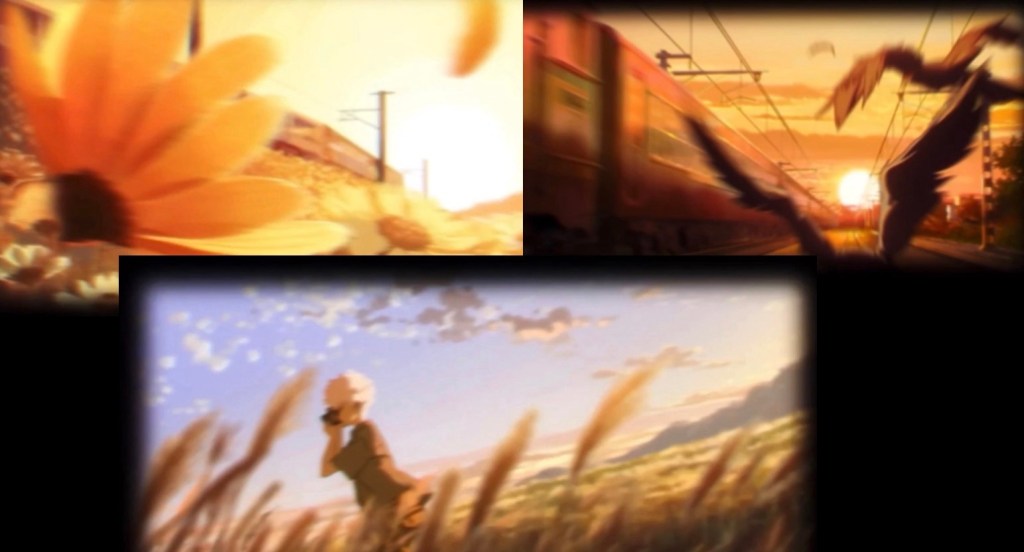
The opening begins with the sounds of a camera focusing and clicking, and what could be film rewinding. There’s a small montage of photos taken by a young Lu Guang, primarily of a train at sunset. A field of sunflowers are the forefront of the first picture, the symbolism of which tends to be happiness – but can also mean a long life, in Chinese symbolism. In the second, there are a pair of black birds, which appear later in the opening too. The regarded symbolism for your average blackbirds are that they represent a change in life, but two together can often represent partnership or duality. A crow can represent the protection of secrets or perspective change. And a raven can often represent the afterlife or returning with new personal power. I thought all these descriptions were interesting when applying it to the story of 时光代理人.
The last image shows Lu Guang taking the photos, which remind me significantly of a scene from the most recent trailer. Futhermore, the next shot is young Lu Guang lifting up a present from young Cheng Xiaoshi to the sun – a little film strip with a cat on it, (that looks a lot like Lu Guang’s representative cat motif) and the words ‘meow’ written around it. This shot was already shown in the first Season 3 trailer, but it was Cheng Xiaoshi who lifted it.
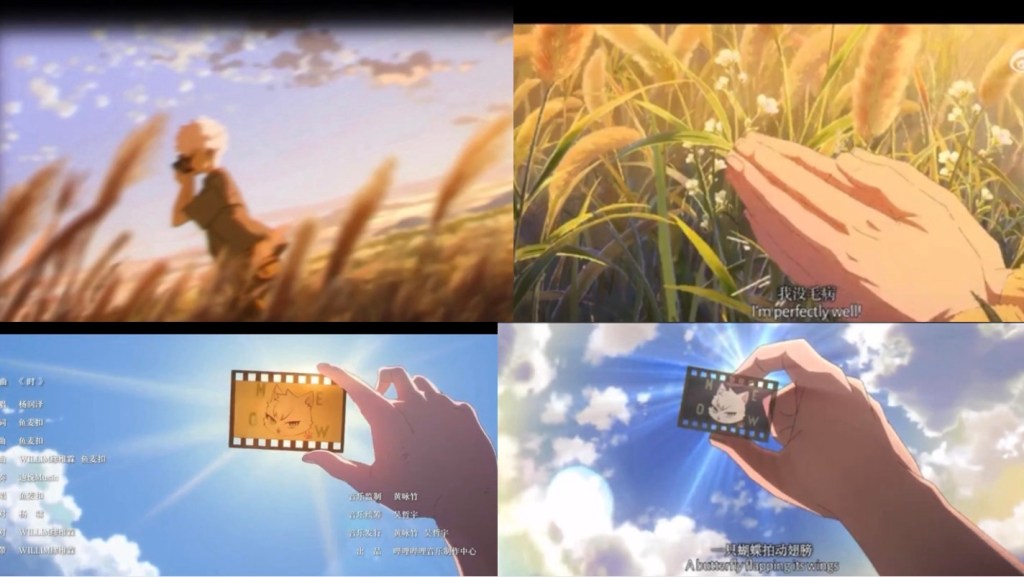
Left: OP, Right: trailers 3 and 1 (in that order.) In the first one, it may be a coincidence both boys are in a corn field, but I don’t remember ever seeing one before. Cheng Xiaoshi claps his hands, (in or out?) and then the colour drains from the scene and he starts sobbing. What if he was reliving whatever memory of Lu Guang that had happened here before? As for the film strip, I like to think it was a symbol of their early childhood friendship. Maybe it was something Cheng Xiaoshi gave to him when they first met, or maybe because he thought Lu Guang needed it. Either way, it’s nice that the whole effect of the gift can only be appreciated by raising it to the light. You need light to see the picture form.
Young Lu Guang prints the photos out of his camera and hangs them up. They seem to be depictions of streets and alleyways, but the first one is a very familiar train tunnel from later in the OP. The same tunnel also appears in a small PV back in April, and from Season 2’s OP: Vortex. More than once, Cheng Xiaoshi is depicted running or falling into the tunnel. On the photo, there is a note written: 1 + 2 Opacity 50%. This is actually a secret that the storyboarder of the opening included with the intention for fans to find. A lot of us have been speculating that when the second opening releases for Season 3 Part 2, (created by the same storyboarder) lowering the opacity of that opening or both to 50% and overlaying them will reveal hidden details. There are a lot of frames for overlay potential, so I’ll point them out as we go along.
On the topic of the second opening, the name of this one – 时 – has brought something to my attention. That character means “time”, pronounced shí. But the fact they called it 时 instead of their so often used 时光 – it was interesting to me. 时光 also means time, pronounced shíguāng, but it is a more softer and often regarded ‘romantic’ way to describe time in an emotional sense. My research also showed you are to use 时光 in situations like writing a song, a poem, a diary entry, or reflecting on childhood memories. Soft emotional moments. But the biggest reason why the word is well known amongst fans is because it’s actually the combined name of the two main characters, Cheng Xiaoshi and Lu Guang. We use shíguāng to refer to them as a platonic or romantic duo. The people who made the show and even the characters are aware of it. (In the live action version, Cheng Xiaoshi even goes out of his way to rename their studio ‘time’ photo studio because it’s their names, not because of the meaning, whereas in the donghua it’s reversed. Either way, he only changes it when Lu Guang moves in, which makes me think he was aware of the alternate meaning anyway.) This is why when I saw the opening wasn’t called 时光, it was strange. They removed 光. Both in terms of the character and also the literal meaning of the name – they removed the light. Other parts of the OP add onto why this is so jarring. However, there is still a second part to release. A second part which almost definitely should be called ‘light.’ 时 and 光.
In the next part of the opening, we finally see Cheng Xiaoshi, who is taking photos also. He lowers the camera and his eyes… are yellow? For certainly not the first time in this OP, we are introduced to the idea that he might be diving. It then cuts to the photo studio, where he sits alone in the sunroom, and the sunset fades to night. (The light is once again extinguished.)
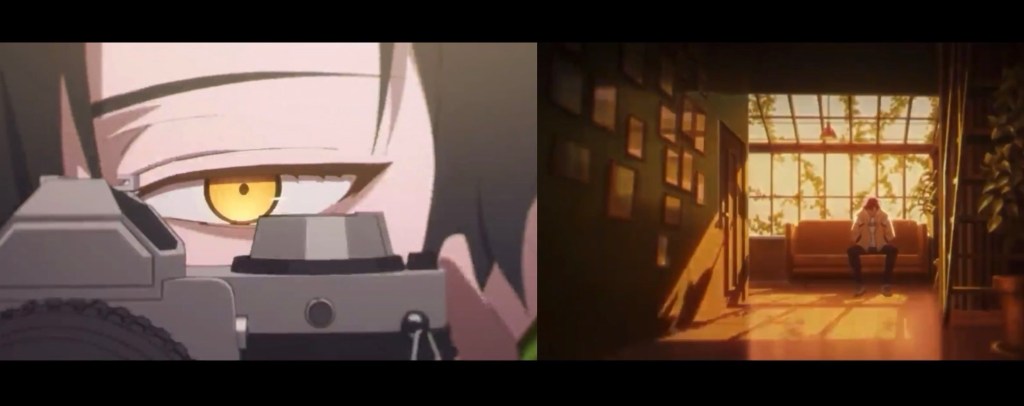
As you can see, the second image has a lot of overlay potential. Cheng Xiaoshi is sitting more over to the right, and if the second opening really is about Lu Guang, I’m sure that when we overlay it we might see Lu Guang sitting next to him. It still disturbs me slightly that they are so clearly separated, but I’m sure we got the impression it wouldn’t end well for them already, right?
The next shot shows the studio clock, which is pointing somewhere around 5:45-ish. There are no numbers on the clock to tell a specific time, so it’s only roughly around this. There’s no obvious symbolism for this specific time, instead what is a nice detail about the clock in this frame is that the hand moves one tick anti-clockwise, like time is reversing, before it transitions to another clock which does the same thing. This clock is part of a cluster of other signs, which all point towards the left hand side of the screen in some way. It is here we see young Cheng Xiaoshi for the first time, who follows the signs across the screen.
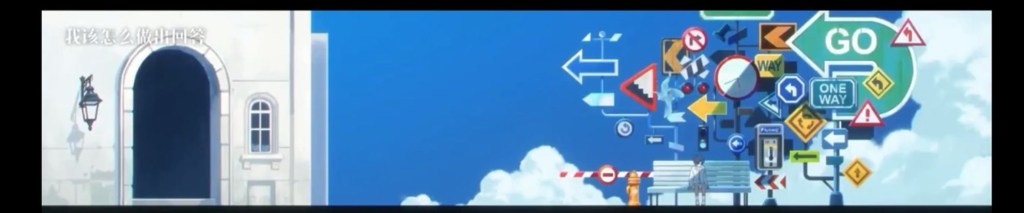
The temple entrance seems to represent an endless maze, as I’ll explain in the next paragraph, and with all the signs pointing towards it – like they’re urging Cheng Xiaoshi to enter the loop,to enter the past. The opening begins to create images of surrealism like this from now onwards, like how the signs contradict the background of clouds and the polished architectural building on the other side. It’s not visible because of my very irritatingly neat cropping work, but there’s an unusually large space under the image that has overlay potential to possibly depict a reflection of the scene, reversed below.
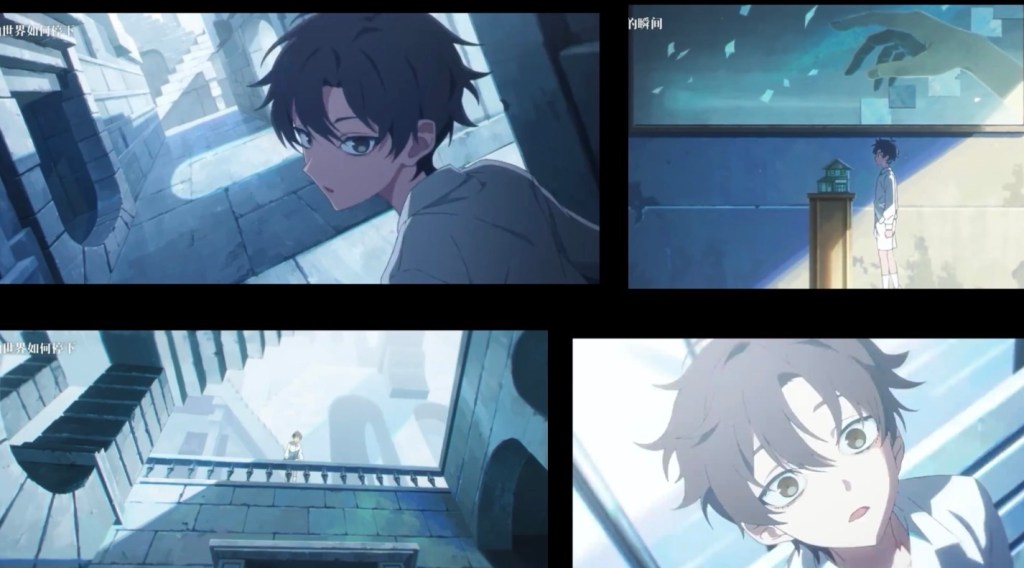
Inside the building, the palette is very cool and the architecture is very reminiscent of M.C Escher’s work, or at least to me. He was a real artist that experimented with impossible building designs and illusions. Whilst the opening itself doesn’t show as much similarity, I still thought about it because of the latest Season 3 poster, which took direct inspiration from Escher’s work, particularly the one below.
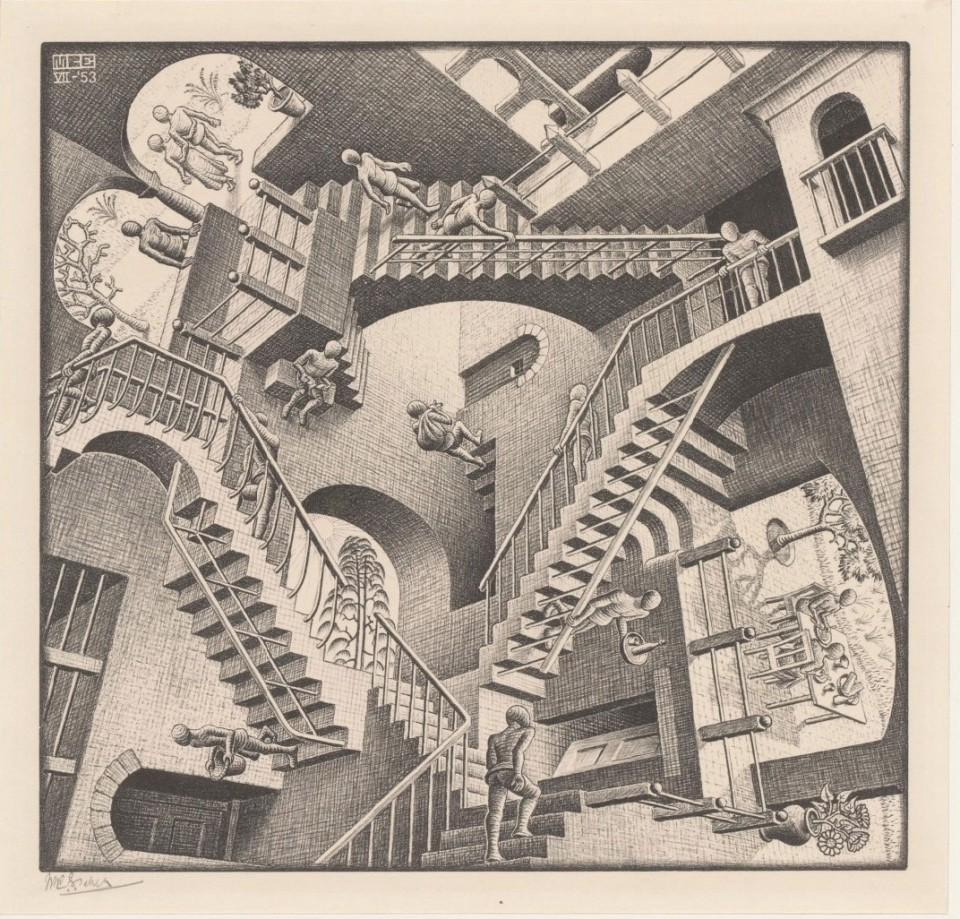
Whilst it was the poster that took inspiration from this – with the staircases and all the characters walking along them in impossible ways like Escher’s work – some of the designs from the drawing do link up with those from the opening. See the railings, the arches above the doorways, even just the arching shapes in general and the angles the opening places itself at that give the illusion things are upside down or distorted when really, it’s just how you look at it.
Young Cheng Xiaoshi is searching for something, or someone, as he walks through the building. The choice of inspiration could mean many things, but I found it curious one of the things Escher looked into was infinite spaces or loops. The figures in his drawing also seem to be looping round in an enclosed space, very reminiscent of the way Cheng Xiaoshi searches what appears to be an enclosed space also. Maybe he’ll be forever searching for that particular someone, looping around and around in a building where laws don’t apply, which is why I compared it to an endless maze. I think it’s also important to note how Cheng Xiaoshi is dressed fully in white, and so is Lu Guang later in the OP, both of them flaunting white shirts, shorts and shoes. In China, white is specifically reserved as a colour of grief, death and mourning – and it’s expected to wear full white to funerals. It has a strong symbolism of showing respect for the dead and those who have passed, but it’s also somewhat customary for those who plan to take their lives to wear full white themselves as a sign of sorrow. Not only this, but historically it can also symbolise ghostliness and the removal of colourful values in life. I don’t need to explain how much it applies to the pair of them, do I?
The next shot is an artistic one of the studio’s sun room again, child Xiaoshi’s yellow eye poking through the glass, watching an empty couch. If we overlay it, I wouldn’t be surprised if we saw Lu Guang sitting there. His eye being yellow means he’s from the future, watching through the window onto the past. The screen drops through some golden gears that appeared once in the Yingdu Arc Episode 2, and onto a shot of a slightly older Cheng Xiaoshi walking up some steps. He looks to be about the age he was in Yingdu, 18 years old, and still wears a white shirt though notably he has black trousers now.
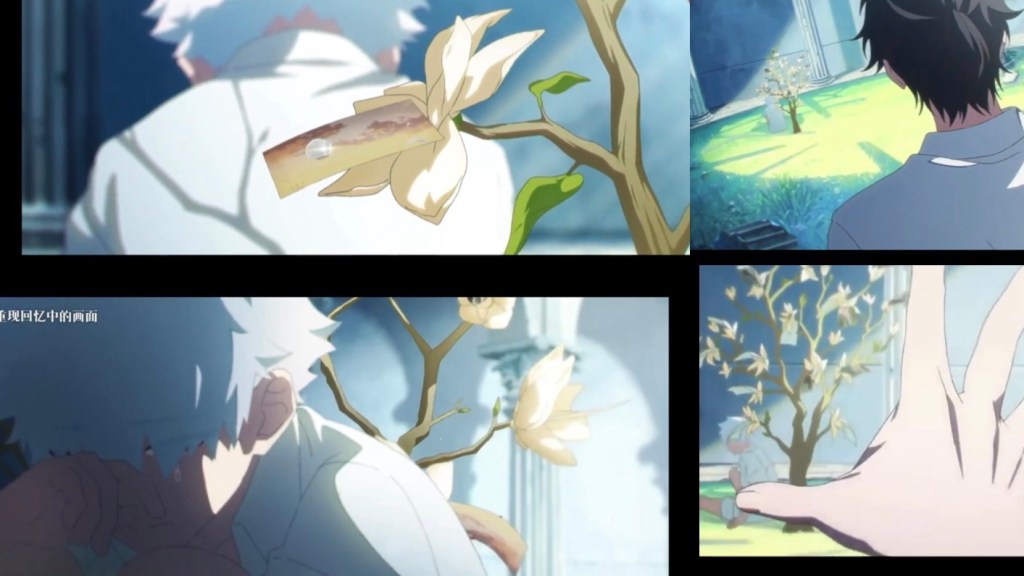
Cheng Xiaoshi arrives in a circular clearing to see young Lu Guang curled up crying on the other side, also dressed fully in white. Interestingly, a tree of white magnolias springs up from where Lu Guang sits, and as the flowers bloom, a photograph falls out one of them. It’s Lu Guang’s sunset photograph that he used to return to the past after Cheng Xiaoshi died, back to when they first met. The flower language of magnolias tend to show they symbolise things like purity, resilience, dignity, etc. but I found it all to be a bit vague. However if you keep searching you might come across one other meaning, which is that magnolias are used often at weddings as they symbolise a strong devotion to one’s partner. I found it sweet that keeping this in mind, the photograph was born from the flower, but you could say it was born from devotion. The idea of Lu Guang travelling back was certainly an act of devotion, but so was Cheng Xiaoshi’s searching for him.
When Cheng Xiaoshi sees young Lu Guang, he makes an expression of distress before running towards him with an outstretched hand. Lu Guang turns around to look at the last moment before Cheng Xiaoshi falls down into a dark room and hits a mirror. It’s like a barrier stopping him from reaching Lu Guang, and forcing him back onto reality by showing him his reflection. Especially as Lu Guang is a child, he’s a thing of the past here, whilst Cheng Xiaoshi is a thing of the future. The mirror serving as a barrier showing him how he’s in the present, and cannot return to the past to save Lu Guang. He turns around, and there are multiple reflections of other characters surrounding him. We can see Li Tianxi, Wang Qing, Emma, Doudou, Xia Fei and possibly Lin Zhen. Interestingly, these seem to be characters that Cheng Xiaoshi has dived as – with the odd one out being Xia Fei. Could this suggest Xiaoshi dives into Xia Fei in the next season? In Escape Velocity, Xia Fei is depicted as some sort of lab experiment, and Cheng Xiaoshi sets out to save him, with yellow eyes. And in the Season 3 trailers, Lu Guang and Cheng Xiaoshi exchange dialogue that suggests Xiaoshi has some sort of intention of going back and ‘saving’ Xia Fei from something. If Escape Velocity taught us anything, then what Cheng Xiaoshi saves him from could be related to the Bahati School of Languages. In the Yingdu Arc Episode 5, at one point when Cheng Xiaoshi dives into Wang Qing, it can be seen that Xia Fei was actually a student there also. What if he was the one to start the fire?
In the next shot, an hourglass falls past a clock which – to my best understanding – reads 4:00. Notably, the hour glass isn’t running out yet either.
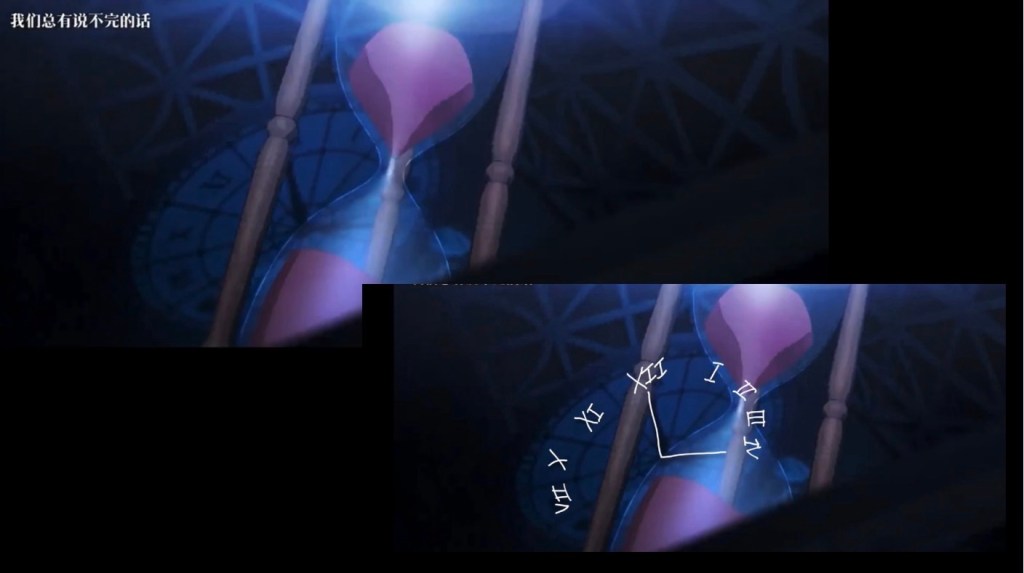
The only symbolism I think possible for this is 4 being a number that represents death in China, and clocks also being a way to represent somebody’s time being up. Gifting a clock is seen as a message somebody will die. In Chinese, “four” and “death” are pronounced differently but spelt with the same pinyin. Death: sǐ 死. Four: sǐ 四. So it’s often avoided being used as it’s a sign of negativity. 4:00 specifically on a clock also has another meaning, as it’s directly in the middle of a period of time in China called 寅时 (Yǐn shí) which translates to “Hour of the Tiger.” This period of time runs from 3AM to 5AM. This hour is associated with the tiger because it was recognised to be the hour in which their hunting became more aggressive. It’s when they are more likely to hunt their prey, and the time where humans most avoid running into contact with them. This reminds me of a few hunters in the show, namely Liu Xiao, and I wonder if it’s suggesting the danger from these type of hunter characters will significantly increase. Credits to my friend (Reddit user: @Sui_2461) for helping me with some of this research!
The hourglass tumbles through a forest where Cheng Xiaoshi is standing, then hits him and smashes into pieces. You’re taking something metaphorical like an hourglass (symbolism for time) and turning it physical by having it affect a character. It feels like when the glass shatters, things are breaking and time spills out of that sort of barrier which kept it under control, and Cheng Xiaoshi is swept up in the sands like he’s consumed by the past.
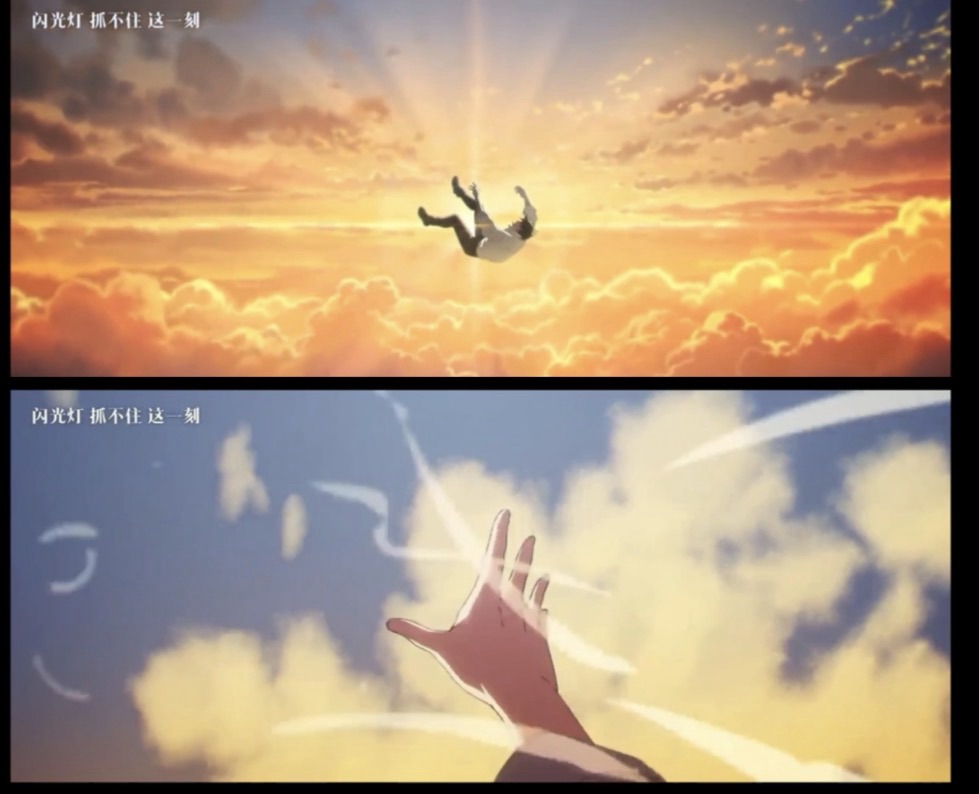
Instead of falling through the sands, now he’s falling through the sky. In the first image, Cheng Xiaoshi is placed directly in front of the sun, with the light sometimes peeking through from behind him, as if he’s glowing. I think it’s supposed to show Cheng Xiaoshi feels like the light, how in this particular scene he doesn’t keep falling, and it hovers for a split second like pausing time to show him enveloped in light. I would say this is an overlay moment, but the composition is perfect with Xiaoshi being directly in the middle of the screen, so instead I’d reckon the next shot (image below) has more potential. His arm is flaying in the wind, he’s reaching up still though, and there’s space for someone to be reaching back – Lu Guang. A white bird flies through the shot and there’s one moment where it looks like Cheng Xiaoshi is trying to catch it, before the screen flips for a moment and the bird flies through a train tunnel. White birds generally symbolise freedom or peace, but sometimes it can be used to illustrate a scene of the soul leaving the body in death. There’s a lot of Chinese folklore when after dying, somebody will turn into a white bird and fly away. With Xiaoshi trying to catch this bird, it could be symbolism of him trying to prevent some sort of death. Or, a less controversial approach, it does simply just represent freedom – and the bird flying through a tunnel doesn’t have any dark meaning for their childhood, instead it’s taking some sort of door back to the past. Especially because afterwards, we see the trio as children. It’s like we’re spectating on past memories.
In between these two shots, there’s one of a comet, which are usually associated with wishes – but sometimes time travel too. (In Your Name, a Japanese anime, a comet is the motif that links the two main characters across different times.) Either it symbolises some sort of bridge between the past and future, or some sort of wish that the trio had as children – possibly to stay together. I can’t help but say it does remind me of a certain quote by Lu Guang to Cheng Xiaoshi from the official 时光代理人 stage play/musical: your hopes are but falling stars, short-lived, but brilliant. Also translated once as, your wishes are like a comet, beautiful but gone before you can catch them. Either way both quotes share the same message, Lu Guang was comparing Cheng Xiaoshi and his dreams to a falling star, because both were a spectacle – but never lasted long. I can’t help but wonder if the comet in the OP was intended to have a similar meaning.
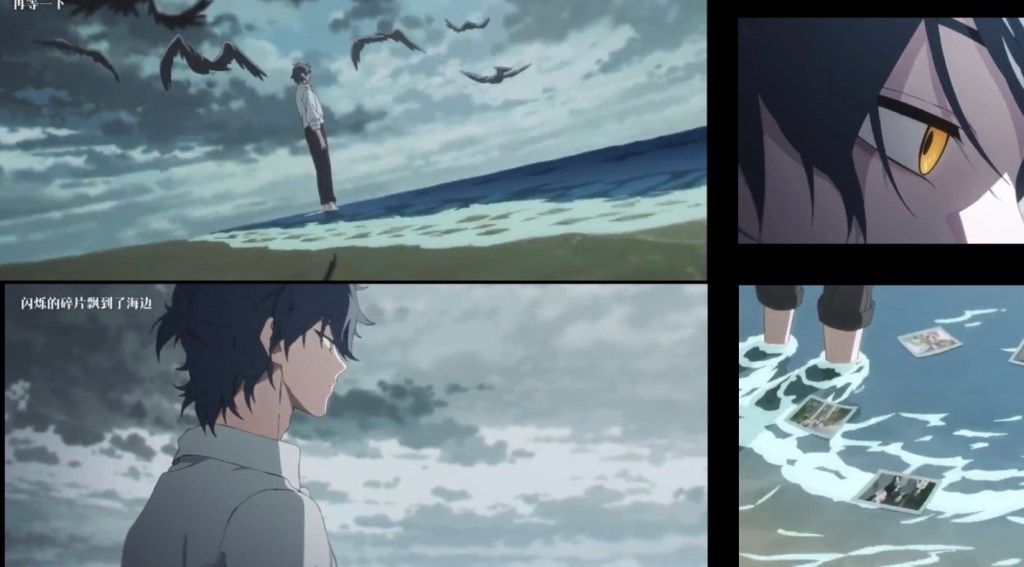
The next shot depicts a large flock of black birds as the foreground, much unlike the singular pair from earlier, before they spread out and show Cheng Xiaoshi standing alone on the beach. The lighting isn’t bright, rather the clouds are dull and the sky is murky, and with a close up to his eyes we see they are yellow. Panning back out, his expression is rather emotionless and depressing, very unlike his usual sunshine self. Photos wash up in the waves just as the lyric shimmering fragments drifted to the shore plays. Satisfying how they match up, the use of the word ‘fragments’ to describe photographs implying their memories are broken up into pieces, no longer a whole, possibly split between them. Maybe because one doesn’t remember? They drift to the shore – in the way a lot of abandoned things usually do. I’ll cover the rest of the lyrics later into the week, I just wanted to touch on that briefly.
In the next shot, Cheng Xiaoshi is swept up by a breeze beside a tall glass building entirely reminiscent of those in the Season 2 OP: Vortex. Actually, that shot is likely a direct reference to it. The frame transitions using photos into the next part, which goes through returning characters from seasons 1 and 2. We see Emma and her family, Lin Zhen and Yu Xia, Chen Xiao and his mother, Doudou and his parents, Xu Shanshan and Qiao Ling and Dong Yi, Li Tianxi and Li Tianchen and their mother, Wang Qing (and a suspiciously Xia Fei shaped head), Xia Fei and Vein – and lastly Cheng Xiaoshi and Lu Guang, as children, who are finally holding hands and walking down some train tracks at sunset.
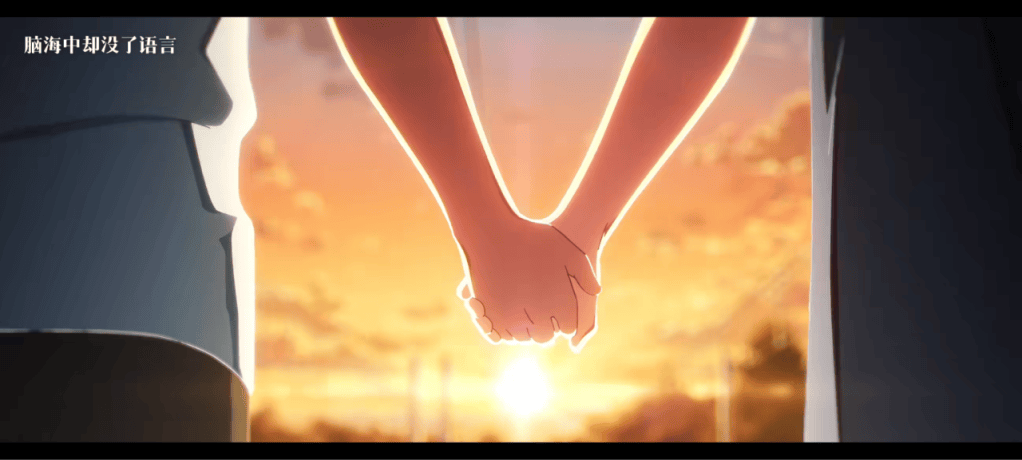
Though I think this shot just has some more satisfying composition, it’s nice to see a subtle reuse of the light imagery, their joined hands directly in front of the sun, which is placed at the end of the train tracks like they’re walking towards the light. This transitions into Cheng Xiaoshi’s hands reaching into the dark, and then hugging the air on the light side of where he is standing. Hugging the light. Hugging 光, yes? On that note – this is probably the frame with the most obvious overlay potential possible, as Lu Guang hugging him back is what the frame is missing. A white butterfly flies past Cheng Xiaoshi, which draws his attention, and he follows it with his eyes – here we see that he has been crying. The white butterfly almost indefinitely represents Lu Guang, not just because it’s a butterfly or it’s the colour of his hair, but because many traditions view white butterflies as sign that the soul of a deceased love one is watching over you/sending a message to you. Deceased. If the hugging-the-air, crying and yellow eyes didn’t do it for us already, I can say with almost absolute certainty now that Lu Guang has likely sacrificed his life in an attempt to protect Cheng Xiaoshi’s, only for Xiaoshi to have the same idea that Lu Guang did.
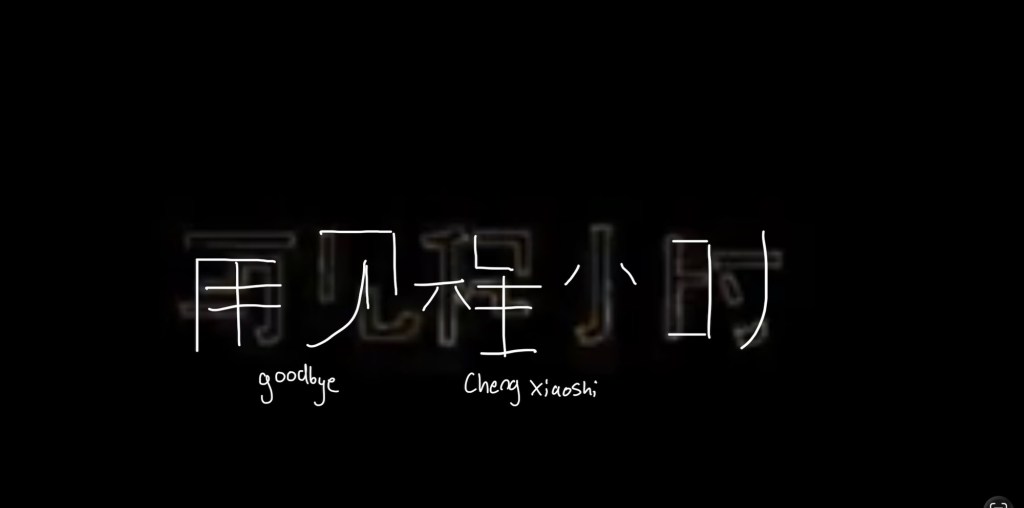
If this wasn’t enough, the OP leaves us with one lingering message on the front over of a book. When filling in the missing strokes, this Chinese sentence, zàijiàn Chéng Xiǎoshí, translates to “goodbye Cheng Xiaoshi.” Originally, I think there wasn’t much panic stirred as the first logical thought was…well, Cheng Xiaoshi is dead. But looking at the rest of the opening, a lot of fans have come to the conclusion this is actually a goodbye from Lu Guang because something is happening to him rather than Xiaoshi. Combined with a lyric from the OP that Bilibili so kindly used as their title, we never thought we’d have to say goodbye, it’s becoming more obvious already the direction the story is taking. In fact, a lot of these hints have been here for a long time, from Lu Guang being prepared to trade his life in Season 1 Episode 11 to “我陆光怎麼又被偷走” (why has my Lu Guang been stolen again?) on screen for a split second in the XETROVerthink music video. Some of the designers commented in the artbook they even intentionally used a lot of halo imagery for Lu Guang, most notably in the Season 1 OP – Dive Back In Time – and the Yingdu Arc Episode 5.
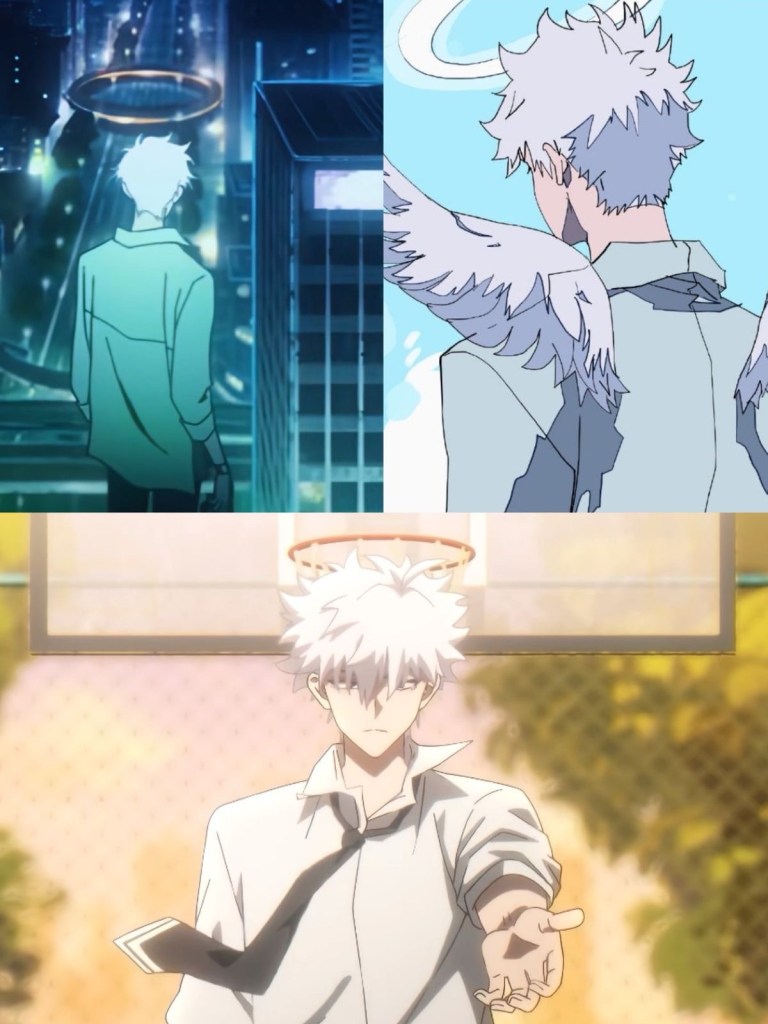
The possibility that Lu Guang could decide to trade his life for Cheng Xiaoshi’s, only for Cheng Xiaoshi to dive back and save him like Lu Guang has been doing – it’s very implied. In fact, Cheng Xiaoshi could follow through with this very early into the season – and dive back to their childhood. I’ll bet that’s why such a big chunk of their story is set in their childhood in Season 3. I wouldn’t actually be surprised if this all plays out in the first episode, just like Yingdu.
If nothing goes wrong, I plan to analyse the lyrics next for Friday. So stick around to see Part 2! Until then!


 Cherryblogs
Leave a comment