The following analysis draws quotes, images, themes, characters and evidence from Episode 6 of 时光代理人 – Yingdu Arc.
时光代理人 is owned by Li Haoling, and produced by LAN studio and CMC media with the help of Haoliners Animation League. The donghua airs on Bilibili with the assistance of BeDream Studios.
————————————————————————————————
The story that 时光代理人 uses is a technique that originated from a real person named Carl Jung, who was a Swiss psychiatrist and depth psychologist. He believed that you could use fairytales as a type of psychoanalytic test that could show a person’s true personality or struggles. He also believed that the subconscious answer given when faced with a riddle hidden in a fairytale, myth or story could reveal something not shown otherwise.
– All research regarding was sourced from psychologytoday.com
______________________________________________________________________
“Once upon a time, in a forest in the southwest, there was some animals. There was a strong elephant, a clever fox, a dove who was the forest messenger, and a seemingly harmless family of rabbits. And while they had their quarrels, this menagerie of creatures lived in relative harmony, working together whenever the need arose. However, one fateful day, disaster struck. In the dead of winter, a fire broke out and spread across the forest. The dove flew as fast as it could, spreading news of the fire to all who could hear. The fox began barking orders and the elephant obliged, acting without regard to its own safety, while the family of rabbits ran for their lives. Despite their efforts, the forest was consumed by the flames. In the ashes of their home, the animals gathered to find out who was responsible, but they couldn’t agree on a culprit. However, they were able to come to an agreement and they used their last gold coin to hire a struggling detective, who happened to be in the area. That detective is you.”
– Vein and Wang Qing, to Lu Guang and Cheng Xiaoshi respectively
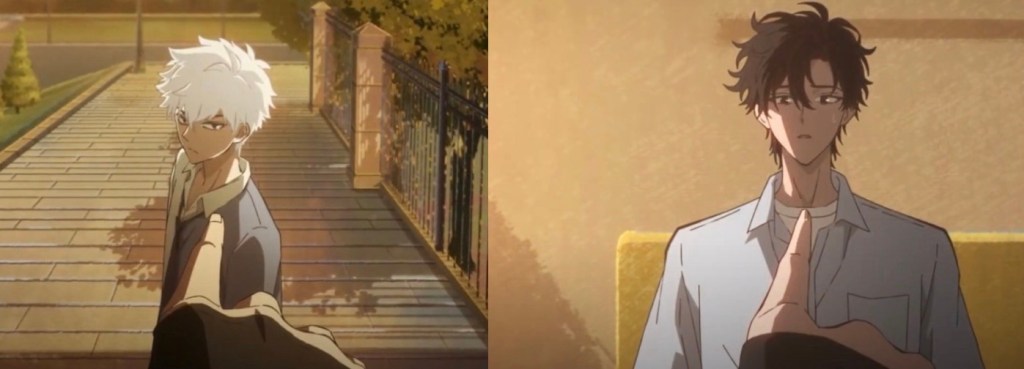
That detective is you – both Lu Guang and Cheng Xiaoshi are placed in the position of the detective by their retrospective storytellers to begin the riddle. Lu Guang (left) is much less receiving of the puzzle than Cheng Xiaoshi (right) and throughout the exchange keeps his face guarded, unlike the other.
The riddle is not a significant part of the episode for no reason, and is actually regarded by fans to be a metaphorical depiction of the Bahati School of Languages from the Yingdu Arc, which was set on fire by an unknown attacker and resulted in thousands of young students losing their lives. Along with them – some teachers, that could’ve included Cheng Xiaoshi’s father, Cheng Weimin, as it was unknown whether he escaped. The parallel is even more likely when you take into account that Wang Qing started her work and created this test after being the only supposed survivor of that very same fire. What all this means is that all the animals shown in the test match up to characters from the show, and from the answers given in show by said characters, we can determine ourselves who the culprit really was.
“Now you have heard the animals’ tragic tale, and in it lie all the clues you need to uncover who is responsible, who was it? Of all those in the forest, who is the one to blame?”
– Vein and Wang Qing, at the end of the riddle
Before we work towards deciphering who it was, it’s important to make a link between the animals and their characters.
NO.1 – The Elephant
The elephant in the riddle is depicted as a strong and kind creature, who when seeing the danger, took it upon itself to find a way to prevent people being hurt – with no thought for its own safety. Even although elephants are usually regarded as slow, or heavy, the animal is still shown to take it upon itself to be a saviour, regardless if it’s right for the job or not. This matches up cleanly with the personality of Cheng Xiaoshi, who is depicted to have a soft and kind nature that leads him to be incredibly self sacrificial, acting on impulse. Like the elephant, he places himself in immense danger to even save one life, being unable to carry the weight of failing to save someone. When the numbers rise, the things he will do become more extreme. His empathetic personality comes from a past of being neglected by his parents (who “disappeared” when he was a child), bullied by the people around him, and forced to fend for himself from a very young age. The elephant acts the same way he would, if put in that situation. This is actually backed up by Yingdu Arc Episode 4, where Cheng Xiaoshi experiences time travel for the first time, and finds himself at the Bahati School of Languages. He attempts to save the inhabitants by running head first into the flames.
NO.2 – The Fox
The fox is shown to initiate instant control over the situation, and tries to order the other animals to act, whilst not doing anything itself. It could be argued that it takes the role of the leader and is therefore not expected to act, but in a dangerous situation, anyone with at least a little empathy would try to do something. This is why I feel the fox best represents Liu Xiao. In the same way the other animals listened without protest to the fox, other characters are seen to revolve around Liu Xiao’s orders. His own motives have never been revealed, instead preferring to keep all plans and thoughts to himself. And he most certainly does nothing, at least, to our eyes. For the amount of time he was on screen during Yingdu Arc, he used it to play poker, Russian roulette, Tetris and watch movies. Yet in the way he acts and presents himself, his own mind is occupied in playing a dangerous game that he fancies himself the mastermind of. Just like the fox, he has a cunning and quick thinking personality, his first impulse in a dangerous situation is to order the others around and below him to act. He has all the answers, yet never carries them out himself.
NO.3 – The Dove
The dove in the riddle is shown as the messenger of the forest, who immediately acted to spread the word and urge everybody to safety, likely because of its advantage of flying. Its first thought was also for the safety of others, another empathetic personality. The character associated with this… is difficult to work out. But the most plausible answer could be Cheng Xiaoshi’s mother, Shao Yuanyuan. She takes the role of spreading the message about the Bahati fire to others, notably Cheng Xiaoshi (in an indirect, roundabout way) to try and protect her husband from the fire. It’s unknown whether she had motives to protect the students also, but being a mother (even if she is a bad one) it’s probably natural for it to be instinct. The dove didn’t just spread the word just to protect its own home, it also did it knowing there were other inhabitants. The dove was also depicted as the first in the list to react, spreading the news before anything else could happen. This likely parallels the way Shao Yuanyuan travelled to the past momentarily to start implanting the idea of a fire before it happened, regardless if anybody believed her or not. Her actions directly parallel Lu Guang’s actions also, for both Cheng Weimin and Cheng Xiaoshi likely experience the same fate.
NO.4 – The Rabbit Family
The rabbit family turn and flee at first sight of the fire, their instinct going to protecting each other and themselves. They don’t hesitate to wonder what happened, or to stop it. This could parallel the students of Bahati themselves, even Wang Qing who, like the rabbit, survived the fire because of the childlike instinct to run. In media and symbolism, rabbits are shown as an icon of innocence, and used in children’s toys and books. To associate rabbits with a bunch of children whose first thoughts are, understandably, to run… is the simplest answer. The idea that the rabbits are then regarded as possible culprits is something only certain people can accuse, which I’ll cover in the next part.
 Cherryblogs
Leave a comment